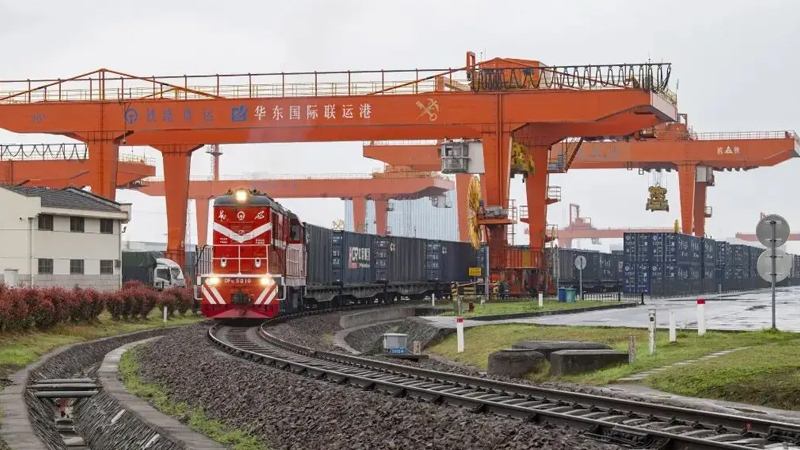
According to the latest data released by Hangzhou Customs on April 14, Zhejiang China-Europe Railway Express (Yiwu-Xinjiang-Europe Railway Express) handled 42,000 TEUs of outbound containers in the first quarter of 2026, representing a year-on-year increase of 21.5%. The growth continues the steady expansion trend of recent years.
What are the key factors behind this growth? The answer lies in three major drivers: the enhanced role of China-Europe Railway Express hub centers, the continuous upgrading of cargo structures, and systematic institutional innovation.
Hub Development: Improving China-Europe Railway Express Service Capabilities
Every Saturday, the Yiwu–Duisburg full-route timetable China-Europe Railway Express departs from Yiwu West Railway Station on schedule, providing foreign trade companies with highly predictable transit times and reliable logistics arrangements.
"The full-route timetable China-Europe Railway Express operates with fixed routes, schedules, departure times, and train numbers, offering greater convenience for enterprises and better meeting the transportation needs of high-value and time-sensitive cargo," said a representative of Zhejiang China-Europe Railway Express (Yiwu-Xinjiang-Europe).
This scheduled and high-frequency operation model has created stronger attraction for advanced manufacturing cargo. The rapid development of the Jinhua (Yiwu) China-Europe Railway Express Assembly Center has become an important example of how Zhejiang is upgrading its international logistics network.
In January 2025, Jinhua (Yiwu) was approved as one of China's 14 national China-Europe Railway Express assembly centers. By implementing the strategy of "one brand, one platform, and one mechanism", Zhejiang has significantly improved its functions in cargo collection, distribution, aggregation, and integration.
After years of development and capacity expansion, Zhejiang China-Europe Railway Express (Yiwu-Xinjiang-Europe) currently operates 27 international railway routes, connecting more than 160 cities across over 50 countries and regions in Europe and Asia.
To further enhance transport resilience and service coverage, Jinhua has continuously upgraded its operation model from point-to-point transportation to hub-to-hub and network-based logistics services. Through overseas distribution centers, participation in the Trans-Caspian International Transport Route, overseas operation platforms, and overseas warehouse cooperation mechanisms, Zhejiang has built a more complete international logistics network.
From the establishment of the Yiwu-Xinjiang-Europe Germany Distribution Center to the launch of the Almaty Distribution Center in Kazakhstan and the Tashkent Distribution Center in Uzbekistan, Zhejiang China-Europe Railway Express has continued expanding its overseas service network, creating an integrated logistics system featuring "railway corridors + hubs + global networks."
Cargo Upgrading: From Small Commodities to Advanced Manufacturing Products
While logistics hubs provide external support, the transformation of cargo structure has become the internal driving force behind the high-quality development of Zhejiang China-Europe Railway Express (Yiwu-Xinjiang-Europe).
"In recent years, the types of exported goods have become increasingly diversified," said Wu Shengjun, chairman of Yiwu Yueda International Freight Forwarding Co., Ltd. Previously, Zhejiang China-Europe Railway Express was mainly associated with Yiwu small commodities such as socks, toys, accessories, and hardware products. Today, solar photovoltaic panels, automotive parts, and smart electronic equipment have become major export categories.
This transformation reflects the upgrading of Zhejiang's manufacturing sector. With the development of new energy, advanced equipment manufacturing, and intelligent manufacturing industries, "Made in Jinhua" and "Made in Zhejiang" products are becoming increasingly competitive in global markets.
To meet changing market demand, Zhejiang China-Europe Railway Express operators have introduced customized logistics solutions, including dedicated trains for photovoltaic products, automotive components, and lithium battery transportation, ensuring safe, efficient, and reliable international delivery.
The strong competitiveness of "Made in Jinhua" has been transformed into real export growth through the Zhejiang China-Europe Railway Express channel. The railway service now supports the overseas sales of more than 100,000 types of commodities annually, becoming an important logistics artery connecting Zhejiang manufacturing with global markets.
Institutional Innovation: From Physical Connectivity to Regulatory Integration
If logistics hubs and cargo upgrading represent hardware advantages, continuous institutional innovation provides the software foundation supporting the stable growth of Zhejiang China-Europe Railway Express.
To improve customs clearance efficiency, Jinhua and Hangzhou Customs have continued promoting innovative supervision models such as "Railway Express Clearance" and "Direct Loading upon Arrival", reducing cargo waiting time at ports and improving overall logistics efficiency.
The "Railway Express Clearance" model integrates declaration, inspection, and release procedures, while "Direct Loading upon Arrival" enables seamless connection from factories to terminals, reducing intermediate handling and lowering logistics costs.
Since 2023, Jinhua has implemented the land-port departure tax refund pilot policy. Export goods loaded at railway logistics hubs can apply for tax refunds earlier, shortening the refund cycle by approximately 15 days and significantly improving enterprise cash flow.
In addition, Jinhua has introduced innovative measures including consolidated warehouse supervision, multi-ticket container declarations, multimodal transport "single document" services, and railway bill-of-lading property rights reforms, providing new solutions for international land transportation rules.
These institutional innovations have broken data barriers between customs, railway operators, and logistics terminals, enabling real-time tracking and efficient coordination of international supply chains. As a result, Zhejiang China-Europe Railway Express (Yiwu-Xinjiang-Europe) has achieved simultaneous growth in transportation volume, efficiency, and service quality.